
What does it take to join Campus VFX?
Want more info?
Ready to apply?
After you have committed to joining Campus VFX, it is important for you to choose the right program. Go through each of our program section to see what suits you best and what you would like to expand your knowledge on. In addition, come to a decision on the career path you would like to take whether it is becoming a Compositing Artist, an FX Artist or a Lighting Artist.
Once you’ve selected your program, it’s time to get your application ready. Contact our Admissions Advisors by filling out the Contact Form to help you through this process as it may feel a bit overwhelming. Carefully review the program requirements and all the required application criteria that you need to meet. Our advisors will ensure that this will be a smooth process for you!
Now that you have everything ready to go, it’s time to submit your application to us for review. You may find yourself worried about your submission and feel nervous about our response. Don’t worry! Our advisors will help you every step of the way and will provide you with regular updates on the status of your application via email.
If your application meets the requirement for Campus VFX, we may contact you for a brief interview to get to know you. We ultimately want a passionate individual that is driven to be successful. However, the most important part of this interview is to get to know your personality and how you will fit into our school. In addition, some preliminary skill tests may be applied depending on your skill-set or familiarity with the program you have chosen.
You did it! You will receive a letter of acceptance through your email inviting you to join us here at Campus VFX. We can’t wait to be part of your VFX journey and be there every step of the way to support you in this process.
Scan, photocopy, or snapshot of high school transcript or proof of age over 19 years such as birth certificate, passport, driver’s license or college transcript.
You will need to submit a financial plan to ensure you have arranged sufficient tuition and living costs for the duration of your studies. If you need assistance on this, please contact our advisors and they will guide you through this process.
Your portfolio should be a demo reel showcasing your skills in the specific program you are looking to apply in.
To do this, you must include 8–10 pieces of your best work in any visual medium, and can include photography, drawing, comic or graphic design, painting, sculpture, website design, and/or digital imagery. For specific program requirements, please click the program title below OR visit the program site using the menu bar above.
Intermediate and Advanced Compositing Artist programs
Students interested in the Intermediate and Advanced Compositing Artist programs should have some photo or video editing experience or have basic understanding of compositing software such as After Effects or Nuke.
Intermediate and Advanced FX Artist programs
It is recommended that all applicants interested in the intermediate and Advanced FX Artist programs should have a basic operational understanding of at least one 3D software package. (Houdini, Maya, Max, Cinema 4D, or Blender, etc.)
It is recommended that all applicants interested in this program should have a basic operational understanding of at least one 3D software package. (Houdini, Maya, Max, Cinema 4D, or Blender, etc.) Also, it is also recommended but not necessary that students who are accepted into the lighting program own a DSLR Camera to bring to class.
The VFX Essentials program does not require prior experience with Nuke, Houdini, or Blender and no portfolio is necessary to apply. This program is built for beginners who are curious about visual effects and eager to learn the fundamentals. If you’re just starting out, VFX Essentials is the perfect place to begin your creative journey.
A personal statement describes your interests, influences, and career goals. This is where you would help us learn who you are and what we should know about you as a person. Furthermore, a letter of recommendation that can be from an employer, teacher, or instructor.
Please contact our advisors for assistance in this section.
We only require a curriculum vitae to prove that the applicant’s studies have been interrupted for at least one consecutive year if the applicant did not have a post-secondary diploma.
If you’re coming from outside Canada to attend one of our 12-month programs at Campus VFX, you’ll need to obtain a Study Permit issued by Canadian Immigration authorities.
For online programs or programs lasting less than 6 months, a study permit is not required. However, additional documentation may be necessary depending on your country of residence.
Feel free to contact us for personalized guidance on the documents you may need.
There is a non-refundable $250.00 CAD fee that can be paid by cheque, Visa, Mastercard or PayPal. Application Fee payments will be paid in full when submitting your application. An advisor will assist you during the application process if you have any questions.
Upon acceptance to Campus VFX, a seat deposit is due 30 days after your acceptance email is received and your enrollment contract has been signed. 50% of the tuition is due a minimum of 60 days prior to the start of the program. If you require any clarification, please contact us.
All remaining balance of the tuition is due at the halfway point of the program. However, students always have the option to pay the tuition in full at any point throughout the duration of the program OR make payments as per your agreed upon financial plan.
For tuition payments, we accept cheques, money orders, bank drafts and wire transfers. In the case of a Student Loan, payments will be accepted directly from the Lender.
As we are an Accredited Institution, Canadian students may be eligible for Financial Assistance from the provincial or federal government student loans program. More information can be found at the Student Aid BC Website.
Each Country and Financial Institution appears to have different rules on issuing student loans. Please check with your Country, Province/State/Districts or Regions.
Listed by Province:
Canada and Provincial Student Loans are available to Canadian Citizens and Landed Immigrants/Permanent Residents who are enrolled in a full-time program.
Government Student Loan funding is based on tuition fees, books, supplies, living expenses, income and available resources and reaches a maximum yearly level that varies province by province.
Applications are available by calling Canada Student Loans toll-free at 1-888-815-4514. General information on the Canada Student Loan program is available at:
Canadian Government Website
CIBC and The Royal Bank of Canada offer student lines of credit.
Useful CIBC Links:
Student Lines of Credit
Useful Royal Bank Links:
Student Banking,
Student Lines of Credit,
Student Banking Package
These student lines of credit often start at a minimum of $1,000.00 CAD:
TD Canada Trust,
CIBC,
Scotiabank,
HSBC
NOTE: The financial options that have been presented have no affiliation with Campus VFX and are listed for information only. Please read carefully the full text (and the fine print) of any contract in which you engage and be sure you understand it before you sign it. Campus VFX is not responsible for terms and conditions imposed by third-party services.
The following estimates provide a general idea of living expenses for students in Vancouver. Actual costs may vary depending on lifestyle and personal choices. For personalized estimates, we recommend using the WorkBC Cost of Living Calculator.
Housing:
Phone: ~$75
Transportation:
Groceries and Household Items: ~$400
Entertainment and Dining Out: ~$300
Social Events: ~$150
Health and Fitness: ~$80
Overall: A single person’s monthly expenses, excluding rent, average around $1,500–$1,700 CAD.
Campus VFX does not offer on-campus accommodation, but our Student Services staff can assist you in finding housing near the school.
While searching for long-term housing, you may want to consider temporary monthly accommodation. This allows you to get familiar with the area and your classmates before committing to a place. Many students choose to find housing together after settling in, which can help reduce living costs.
Since you’ll likely be spending most of your time at the school, short-term options like Airbnb can also be a convenient choice for your first days or weeks in Vancouver.
Housing in Vancouver
There are several online platforms where you can find rental listings in Vancouver. Some of the best options include:
As with any online rental search, stay cautious of scams—never send money before viewing a place and verifying the landlord.
For additional guidance, feel free to reach out to our Student Services team!
Tenant Rights in British Columbia
As a tenant in BC, you have legal protections regarding rent, privacy, and tenancy agreements. Learn more about your rights at the BC Government’s Tenant Rights page, including:
Our programs do not qualify for a Post Graduate Work Permit.
If you are not a Canadian citizen or permanent resident:
• A study permit is required for our 12-month on-campus program in Vancouver.
• A study permit is not required for our 5.5-month programs offered through Montreal, as they are under six months in length.
If you are interested in our 5.5-month programs for Effects TD or VFX Compositing, you may begin with ourBeginner–Intermediate program online and then continue with the second portion of the program, the 5.5-month Advanced FX TD program or 5.5-month Advanced Compositing program, respectively, through Montreal on campus.
Students may also choose to complete the full 12-month program fully online or fully on campus through Vancouver.
Program clarification:
• Our 5.5-month Advanced program is the second half of the Beginner–Intermediate pathway.
• Our 12-month Advanced program is a standalone, comprehensive program that includes the full curriculum.
We support our international students at every stage of their relocation journey.
During the application process, our team provides guidance on study permits and immigration requirements. Once accepted, we assist with next steps such as navigating required documentation, securing medical insurance, and offering housing recommendations.
Beyond logistics, we are committed to helping students feel settled and supported. Throughout the program, students have access to a range of academic and student services designed to help them succeed both professionally and personally. You can explore these services on our About page.
We also invite you to review our community integration resources outlined above.
Whether you study online or on campus, you will have access to our systems, render farm, and required software.
Students are only responsible for providing their own headphones and an external hard drive.
Online students will also need a computer and internet connection to remotely access their personal on-campus system.
Not at all! We have 2 intake dates for our programs per year. One in March, and one in September!
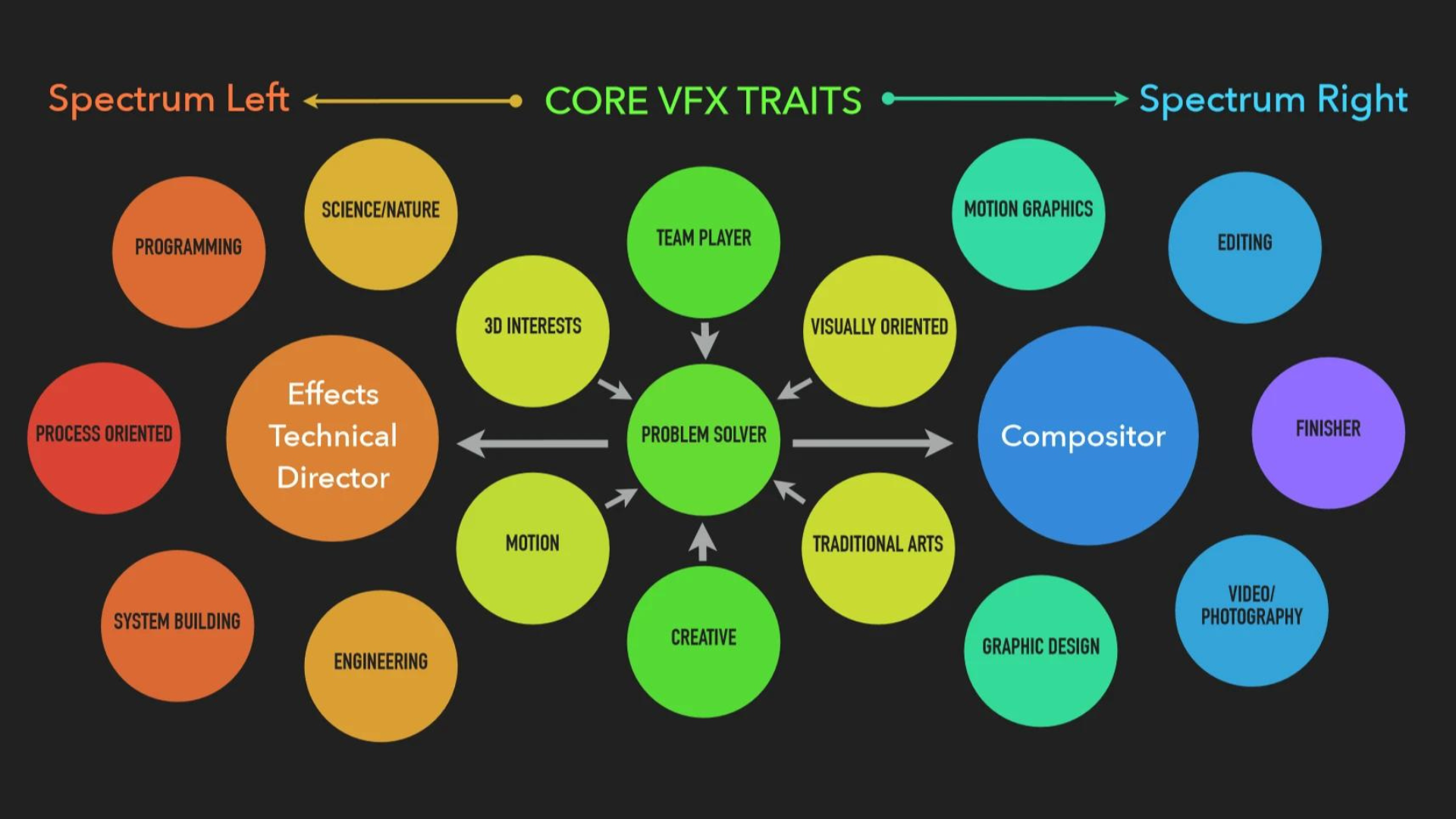
Figuring out which path to take in VFX can be challenging, especially if you’re just starting out. That’s why we created a helpful visual comparison of our main programs to guide you.
FX TD focuses on the technical side of VFX: simulations, procedural workflows, and problem-solving. If you’re drawn to logic, tools, and dynamic effects like fire, water, or destruction, this is for you.
Compositing is more visually driven. It’s about crafting the final look of a shot, combining all elements (CG, live action, effects) into seamless, cinematic imagery.
Lighting sits at the intersection of technical precision and visual storytelling. You’ll work in 3D environments, balancing realism and artistry to bring scenes to life, often in close collaboration with Compositing.
If you’re unsure where you fit just yet, our Essentials program gives you an overview of the entire VFX pipeline, from modeling and animation to lighting, effects, and compositing. It’s a great way to explore your interests before choosing to specialize.
Still curious about VFX roles and career paths? Check out the excellent breakdowns from ScreenSkills.
Let us know any question you might have from our programs to your application.
Get in touch today.